Much
though I respect the man’s stubborn muse, I have ended up imagining in pretty considerable detail the album I wish Bob Dylan would make, wherein, compelled by the
tragedy of Trump’s America, Bob returns to his protest routes, while combining
elements of his austere early-60s roots with echoes of the mid-70s “Rolling
Thunder” tours.
The album
will be co-produced by Dylan and Jeff Tweedy of Wilco, with backing
vocals/duets by and with Mavis Staples and Emmylou Harris:
It’s the connections that bring me to life. Not fate and faith, but coincidence and connection. I’ve been thinking about W.B.
Yeats. Reading about Van Morrison’s album Astral Weeks, I saw it described as
‘Yeats-inspired’ and something fell into place.
I’ll tell you about my father, Patrick McGaughey, an
Irishman who died in 2010. His favourite poem was ‘The Lake Isle of Innisfree’
by Yeats, which was read at his funeral.
I will arise and go now, and go to Innisfree,
And a small cabin build there, of clay and wattles made;
Nine bean-rows will I have there, a hive for the honey-bee,
And live alone in the bee-loud glade.
And I shall have some peace there, for peace comes dropping slow,
Dropping from the veils of the morning to where the cricket sings;
There midnight’s all a glimmer, and noon a purple glow,
And evening full of the linnet’s wings.
I will arise and go now, for always night and day
I hear lake water lapping with low sounds by the shore;
While I stand on the roadway, or on the pavements grey,
I hear it in the deep heart’s core.
I knew my father well and I loved him
well, but I did not often see that side of him, just mere remnants. I knew him
as an ex-husband, a Sunday father, a rugby fan, a barfly, a whiskey drinker, a
struggling occasional accountant. I rarely saw glimpses of the youth where he
may have been brilliant, reciting poetry, translating English into Latin,
coming top in exams, excelling in sports. The Times crossword connected the
young and the old – he could always do the Times crossword.
When we used to go to his flat off the Edgware Road (this
would have been the late 80s) we’d listen to recordings of children’s folk
songs by The Clancy Brothers and Tommy Makem – When I Was Young …, There’s a
Big Ship Sailing, Shellakybooky ... etc and we’d sing them in the car. He was a
terrible singer, it would amuse us to hear him sing.
It was a thrill for me years later, reading up on Bob
Dylan’s early years in New York, to discover he was a huge fan of the Clancy
Brothers and a good friend of Liam Clancy. They used to sing old Irish rebel
songs in the White Horse Tavern in Greenwich village. The night would often finish with a rendition of The Parting Glass – on which Dylan based the
closing track on The Times They Are a-Changin’, called Restless Farewell.
My father Paddy loved Yeats and the Clancy Brothers, he was
a big, balding man with ginger hair who drank whiskey, had a good line in jokes,
played for London Irish (The Exiles, as their romantic nickname still has it)
3rd XV in their amateur days at Sunbury-on-Thames. Have you got the picture, da
big oodea? He was Irish. Thoroughly Irish. Even though he first came to live in
England before he was 20, he remained wholly Irish all the way, would have been
horrified if anyone had thought otherwise.
So now I’m going to talk about Irishness and me, as honestly
as I can, because I know that someone who sounds like me, who has never lived a
day in Ireland, can’t truly be Irish, I know the scores of people around the
world playing on their overblown Irish roots are a bore.
So I’ll just tell you how it works for me. Some of this
stuff I’ve only recently deciphered as an in-any-way unified set of facts.
I always called myself Irish. I had a choice of
nationalities – born in England, Scottish/English mother, Irish father, I could
have attached myself closely to any of those, or just gone with British. I
haven’t really, in my deepest marrow, felt - specifically and precisely - any of them, but I’ve worked hardest at the
“being Irish” bit.
In one sense it is inescapable – my surname is Irish and my
face - barely congruent with the flat West London vowels that droop
apologetically or project pompously from it, depending on mood - is Irish.
Somehow, I’ve never felt at all Scottish, though it was our
mother who wholly raised us, though Edinburgh, rich in personal and familial memory, has always felt a second home to
me, and St Andrews was indeed my home for four years. I love Scotland, feel
kinship with Edinburgh and with Fife, but I’m not Scottish, I don’t seek to be.
I didn’t need to be. That part of my identity was sealed and
certain. I was my mother’s child, taking in her warmth and wisdom every day.
She was not and is not concerned with patriotism, actively rejects it if anything - none of that was a big deal. But
throughout my life, I’ve gravitated towards ideas of Irishness, perhaps to make
sense of and fill the space of the parent not there – if half of me was Irish,
I needed to make it so myself, it wouldn’t take care of itself …
Sometimes this quest for identity was pretty desultory and
embarrassing, whether it was evenings irritating the hell out of people by
trying and failing to talk in an Irish accent, trying but often failing to
wholeheartedly support Ireland when they were playing England at rugby, or trying and failing to understand the first bit about Irish
politics …
Plenty of peers were willing enough to take my affectations
seriously, to the extent they’d call me a bog-trotter, a potato-eater, an IRA
member etc. all in good banter! … funny times … Irishness was still not something to be entirely
comfortable with in England in the 1980s. The oddest memory I have was on an
“outward bound” type course, where one of the instructors used to be a soldier. He told us he’d served a couple of years in Northern Ireland, when a boy I knew,
10 or 11, a boy I was reasonably friendly with indeed, said to him merrily
“Must have felt good to pump some lead into the Paddys, eh?” … This kind of
grand witticism does not emerge in a vacuum.
So there was a perverse pride in Irishness as an outsider
identity, but still not something I could quite put my finger on. I’d think of
myself as London Irish, glad to incorporate the name of the club I’d spent many
happy afternoons as a child, the unforgettable clank of boots on concrete
reverberating in the tunnel, the moustaches and the bellies, the heady smell in
the bar of beer, cigarettes, sweat and smoky bacon crisps, and the question “Is
this your boy, Paddy?” at any given time being asked at seven different places
in the same bar. Yes, this was Paddy’s boy.
Rugby was an internal struggle for me when I was young. I could not
work out my approach to it. It was a point of contact with my dad (though his
original sports were hurling and Gaelic football) but too much enthusiasm was a
betrayal of my mother. Rugby stole her co-parent for a decade.
Even when I was good at rugby, I was hesitant, could not
throw myself into it whole-heartedly. And if there’s one thing you have to do
with rugby, it’s throw yourself in whole-heartedly. So I became miserably bad at it, and resented it all the more. I maintained an interest in
rugby enough to make good conversation, but football and cricket (and everything else!) were always my
preferred sports.
I wanted to “be” Irish but also never wanted to fall into
the traps of Irishness, as my father had done. I was my mother’s son, and I
wanted to be conscientious, kind and clear-headed, as she was. Booze and fags, guilt and bullshit, I’ve managed to limit my input and output, thankfully.
There were other dangers in Irishness for his generation – I wondered what effect it had on him and 1000s of others not to be allowed to write with his natural left-hand. My own left-handedness is as central to my identity as my Irishness, perhaps even more so. I saw that the
Catholic church had affected my father and all his siblings in some way. When I
had faith as a teenager, it was a demonstrably Anglican faith, a diversion from the Catholicism I was born into.
I escaped all the dangers of Catholicism, real and
spiritual. The Catholic boys’ school I left aged 8 turned out to be an
institutionalized den of vipers. The Church of England boys’ school I went to
had vipers of its own (which I also evaded) but I think it was less
all-consuming, less systemic and less tied up with the culture and religion of it
all. I anglicised as I grew up, I left behind Catholicism, and also, as I
became a teenager, had less time to see my dad as often on a Sunday (the two facts distinctly connected, as it happens).
Yet still I would call myself Irish, still it was important
to me, though I knew not quite how. There was a lot to contend with, a lot to
try and understand, but it wasn’t until I was 21 that I heard a voice and an
attitude which chimed with my own version of Irishness, the voice of a boy who
grew up Irish in the west London suburbs.
I’d like to tell Kevin Rowland what he means to me one day.
I saw him outside a pub in Shoreditch a few years ago, looking splendid,
looking every inch like you’d hope he would. Not all his looks have been that
well-received. In mainstream consciousness, he will forever be a curly-haired, unkempt gypsy in dungarees singing that incredibly annoying song, the song that two of
my friends strictly (their only strict instruction) forbad me playing when I
DJed their weddings.
I always knew Come on Eileen (who fucking doesn't), but it wasn’t until 2000
that I bought my first Dexys Midnight Runners album, encouraged by an
enthusiastic review of a re-release of their debut Searching for the Young
Soul Rebels. I bought it for a flat £5 from CD Outlet on South Street in St
Andrews from Kenny Anderson/King Creosote (that’s a whole other rabbit hole of
connections to go down).
I loved it instantly, and love it more to this day. The
opening song, ‘Burn it Down’ is such a bold, abrasive yet inclusive tour de
force. It accomplishes so much within one song, dismissing the music trends of recent
times (prog, punk and ska), then, thrillingly, challenging notions of dumb
Irishness by reeling off the names of great Irish authors (all to the accompaniment
of belting horns, the sound of the young soul rebels). It sounds so personal to
Rowland, like he’s shouting back at years of being called a stupid paddy at
school in Wolverhampton then Northwest London. Oh yes? How about … Oscar Wilde
… Brendan Behan … Samuel Beckett … etc
Rowland’s proud vision of the Celt in exile was one I could
embrace. As I investigated Dexys further, I fell in love with his different
iterations of Celtic soul, inspired by Van Morrison, whether as pastiche of
American soul or closer in sound to Irish folk music, and his idiosyncratic
lyrics, often seeming like lines from a personal manifesto he’d been building
for decades: “Maybe it’s time you welcome the new soul vision”, “Now just look
at me as I’m looking down at you”, Give me a record that cries pure and true”,
“Bill Withers was good for me, pretend I’m Bill and lean on me” and from the epic Until I Believe in My Soul, so many, like the comically spluttered “on the
train from New Street to Euston, trying to get the feeling back that I had in
1972” and “Gonna punish the body until I believe in the soul” – I loved the
line, though I never got round to believing in the soul again, I was more
inclined to punish the body until I could run 10 km in 40 minutes, but, you
know, we can’t all be Celtic soul heroes.
And the one that really got me, that sent shivers down my
spine like nothing else, in ‘My National Pride’ from the album Don’t Stand Me
Down – “my national pride is a personal pride, where I come from” he sang. It
seemed counter-intuitive and I questioned myself, thought myself a hypocrite for this emotional response. Pride and patriotism were and are both concepts I’ve
fled from, even reviled … and yet … it was personal, that was the point. He might as well
have been sing “my personal thing is a personal thing, where I come from”.
I couldn’t pretend to be Irish like real Irish people, or
indeed to be a proud Englishman, because I wasn’t, but I came from somewhere, I
identified with something, and it was allowed to be personal, it didn’t have to
be about a proscribed collective identity. I also, though, identified with
Rowland’s admission that he’d originally called the song Knowledge of Beauty rather than My National Pride because he was ashamed of expressing his pride.
Some wags would call that pretty irish.
They played that song on xfm after Ireland had put up a good
show in the 2002 World Cup, and it made even more sense. The Irish football
team was, after all, for all the mongrels – since the Team that Jack Built in
the late 80s, every kid with an Irish grandma could be proud of the green.
Well, so could I. I watched Robbie Keane’s late equalizer against Germany that
year in O’Neill’s on Shaftesbury Avenue, full of folk drinking Guinness at 9am
– doesn’t get more cod-Irish than that …
I was working in Blackwell’s, Charing Cross Road, that year,
listening to Dexys all the time, but, as a perfect example of how botched and
skin-deep my Irish epiphany was, when the store had an “Irish offer” for St
Patrick’s Day, I bought Borstal Boy by Brendan Behan, A Star Called Henry by Roddy
Doyle (fine so far) and Full Time by “Irish” footballer Tony Cascarino, a book
whose most striking revelation was that Cascarino actually has no Irish blood
in him at all. No, I did not suddenly (or ever, actually …) become an expert in
Joyce and Beckett – that would be far too much like hard work.
But I reached out for and found the connections everywhere.
I loved that the song Reminisce from Don’t Stand Me Down refers to a young
Kevin walking down the Edgware Road, that least glamorous thoroughfare within
touching distance of Central London where Paddy McGaughey made his home from
his divorce until his death, full of shisha lounges on the main drag, while the
pubs on the side streets were filled with skulking old Irishmen complaining
about all the immigrants! Ha …
I’d worked in a hotel just at the Oxford Street end of the
Edgware Road a few years before, a massive great cube of a hotel, doing night
room service down its endless corridors to get some money together for my gap
yah in Africah, Kenyah, to be precise. Rilly rilly cool.
Needless to say, I did not set all this hard-earned cash
aside for the big trip. I had my own money like I’d never had it before and I
was going to spend and spend big! The tape section of Virgin Megastore Marble
Arch knew not what hit it - £6.99 for Blood on the Tracks, £6.99 for Blonde on
Blonde, £6.99 for What’s Going On, £6.99 for Astral Weeks, this fabled
masterpiece by Van Morrison.
I’d already listened to a few of the fabled masterpieces.
Pet Sounds I had loved, but I cannot say it took me to another place. It was
beautiful and brilliant but the lyrical concerns were very much earthbound. And
for all the exquisite arrangements, they were all pop songs. God Only Knows and
Caroline No are beautiful pop songs, but they’re pop songs.
Astral Weeks was something else. It still is. I’ve been listening
to it (along with Dexys) as I write this piece, trying to let it help me take
me everywhere I need to go with it.
When did I first lose myself in it? In the rain outside
London Bridge station, perhaps, meeting some fellow travellers I was going to walk with
(again to raise funds) from Southwark Cathedral to Canterbury Cathedral. I
waited in the wrong place (no mobiles), Astral Weeks on my Walkman, not a thought in my head, and delayed Le Grand
Depart by an hour. The 100s of time I’ve been through London Bridge since, I
still chuckle about it.
When else? Oh, let’s die in the shame of the cliché. Me and
my friend Wieland, living in our little place (we named it 61: Momentarily Hard
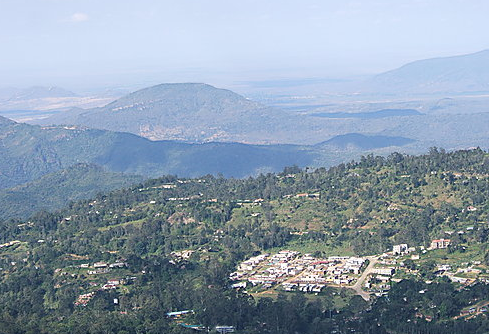
Chemka, the wags we were) on our hillside in Taita, southern Kenya, gifted with
a little verandah (sounds colonial and luxurious, I assure you it wasn’t) from
which we could look out and across, all the way to northern Tanzania I reckon,
we’d sit, suddenly with all the time but none of the necessary distractions,
and talk and talk, often about music and literature, in both of which Wieland
was a thousand miles ahead of me. Sometimes, his taste and his art was a little
hemidemisemiquaverous for my understanding, but we found plenty of common ground,
and we also found someone we could rather foolishly buy weed from. I don’t know
quite what possessed us. Neither had ever done such a thing before in the safe
confines of West London, but, you know, time stretches out up those sides…
So, to cut a long sub-story short, the first time I got stoned,
we were listening to Astral Weeks, and at one point, when I was feeling a bit
queasy and bewildered, I thought of that bit in Beside You where Van sings “you
breathe in you breathe out, you breathe in you breathe out, you breathe in you
breathe out and you’re high, high on you’re high-flying cloud”, but instead of
being high on my high-flying cloud, I vommed, vommed on the low-lying ground.
But that, disgusted reader, did not put me off those Astral
Weeks. Anything but. In those long unlit evenings of staring at those same
stars in that same sky they’d be seeing back home, I remember Wieland telling
me he’d taken to composing more than writing because there were things he could
express with music more than he could with words, and I can see how that’s true of
most words. It’s true of my words, it’s true of Kevin Rowland’s words, much as
I adore them, it’s even, mainly, true, of Bob Dylan’s words, but I didn’t find
it to be true of the words Van Morrison found for Astral Weeks. They
contained an inimitable, mysterious, spectral poetry, a transporting grace and vision.
It felt with Astral Weeks like the words were the music and vice versa.
I can see now how it was inspired by Yeats, perhaps by the
Lake Isle of Innisfree. They share a yearning for a rural idyll, a wonder at the
power of nature. Yeats was apparently inspired to write The Lake Isle of
Innisfree while walking down Fleet Street, dreaming of an island on a lake in
Sligo from childhood holidays. Astral Weeks seems a paean to various aspects of
Morrison’s childhood in Northern Ireland, both rural and urban – yet also
refers to his present, on Ladbroke Grove of all places, another of those
glamourless but glorious West London thoroughfares, not so far from Fleet
Street or the Edgware Road.
I imagine now my father walking down Edgware Road (or indeed
Fleet Street) thinking of the Lake Isle, perhaps the real one, on Lough Gill in
Sligo, or his own personal lake isle. There’s a good chance he did holiday in
Sligo as a child – he took one of my sisters and I there in the summer of 1985
on a little round-Ireland jaunt, when I was 6 and she was 8.
We took the ferry at
3am from Fishguard to Rosslare (I still remember looking at my watch – 3.07,
I’ve never been awake at 3.07 before, I mistakenly thought) and started off in
Cork, made our way up the West Coast, a day or so in each place, but the
longest and most memorable bit was in Sligo.
We stayed in a village called Rosses Point. I remember there
was a pub and fish-and-chip place, and I remember running up and down outside
the pub pretending to be various second-tier West Indies fast bowlers of the
era – Franklyn Stephenson, Winston Davis, Anthony Gray, that kind of thing, you
know? That was perfectly normal behaviour for a boy who spent most of the
trip inventing, ball for ball, test match innings of Chris Broad and David
Gower and writing them in my notebook.
Across the bay from Rosses Point were a couple of islands –
the larger was called Coney Island (not, actually, Van Morrison’s Coney Island
or Lou Reed’s Coney Island (baby), but still …), the smaller called Oyster
Island, and we were able to stay on it for a night or two, on a farm belong to
a friend of my dad’s. There were a couple of hens called Maggie and Scargill who
shat on the floor everywhere and I kept on worrying they were going to shit in
my bed, there was a woman who kept on telling me I was a girl, not a boy, and
there was an extremely tall boy called Fenton. Who the hell’s called Fenton? I
thought, a question I would not have answered until a dog chased some deer
across Richmond Park decades later.
It was a memorable time, a memorable place, we’d occasionally
talk about it, my father, sister and I. He’d report back to us on the wellbeing
of the island’s owner long after we’d forgotten what he looked like.
As children, we went far and wide with my father, often to
Dorset, often to Sunbury, up to Radlett in Hertfordshire, or all around
London. As I got older, our meetings were more concentrated on the Edgware Road
- the Duke of York, Windsor Castle or Royal Exchange.
We’d met around Christmas 1996, after my months of working
in the Mount Royal hotel, just before I was due to head out to Kenya. Over the
course of the early evening, my dad became unusually regretful and melancholy,
you could say speaking to me man-to-man for the first time. I don’t remember
all the details, but I remember I ended up, though not openly, angry at him for
about the only time I can remember. There’d be plenty of disappointment, pathos
and pity, but I generally had no use for anger. I felt unwritten rules had been
broken this time, though, and, when it came to it, I didn’t want to hear his
side of the story.
I sat in that olde Celtic bistro, McDonald’s, by Marble Arch
(where I’d also often go before a shift at the Mount Royal), recalibrating and
sobering and seething in a way to which I was unaccustomed. I had my own way to
go. Right then, I had my own shit to deal with, mainly panic and reluctance to
be heading out to live somewhere (I knew not precisely where) without
electricity and running water for 8 months.
Well, it turned out all right. We were given a nice little
house with a verandah to live in, on a hillside, and though there was no
electricity and running water, there was a post office and we could buy Fanta
and boiled sweets.
The Taita Hills were wildly beautiful and notably verdant.
That lush fertility was somewhat under threat when we arrived, though, in the
middle of a drought, we were told. The last rains hadn’t come, and so people
were very hopeful the downpours would start soon.
Crops were suffering, livestock was skinny, water was
rationed. It was quite a change of environment, but I had my tapes, I had
boiled sweets, I had Wieland to talk to, I had letters to write and receive. To
my shame, the letter I sent to my dad in the first week, to which I was puzzled
not to receive a response, was to the wrong postcode, so took a couple of
months to arrive. Stupid.
The rains stayed away. Week after week. Everyone was getting
worried. It doesn’t take long to feel, inescapably, part of things. There were
weird consequences. One night, we looked across the valley at the forest of
Choke [pron:Chok-ay] and it was on fire. What the hell? We discovered the next
day that the fires were lit deliberately by superstitious locals trying to
summon the rain gods. Though Christianity, fearsome fire-and-brimstone
Christianity, was dominant, out in “the villages”, the deeper villages,
existing faiths still had a place.
An even graver threat, or what seemed like it, emerged from
the forest. This is going to sound silly, I know. But it didn’t feel silly at
the time. A python was found near our house and we were told by a friend of
Wieland’s (probably rather gleefully and mischieviously) that the drought and
the accompanying lack of food were driving the pythons out of the forest to
look for fresh meat.
I mean, it wasn’t nonsense. Kids in my class saw pythons,
there were black and green mambas around in any case. But suddenly, something
vaguely present became a powerful and pertinent threat. There I was, in late
February 1997, enduring several sleepless nights in a row with a Victorinox
penknife in my hand, blood chilling at every rat, beetle, bird I could hear,
thinking a cohort of malevolent hungry pythons were going to come sliding over
the gap between the wall and the corrugated roof.
I had my “Common People” moment. Hang on, I can just go home
now, can’t I? Or maybe spend a few days in a nice hotel in Mombasa or Nairobi.
But I also felt I couldn’t. That was not allowed.
Anyhow, can’t quite remember how, but we stopped worrying
about pythons. Then the rains came. First there was a little harbinger, while
we were at a wedding in the nearby town Wundanyi, a sudden blast from the
heavens, people suddenly laughing and crying and dancing with joy, then it was
over after 15 minutes. Then nothing for another week.
Then, March 8th, the rains came for good. A real
rain, as Travis Bickle would say. And stayed. Not 24 hours of every day, but
plenty of every day, and with an unimaginable force.
When I think of Taita, I think of music. I think of my
tapes, the select few I could pack, in the days before mp3s. Above all, there
was Astral Weeks and Blood on the Tracks. I think of Shelter from the
Storm when I think of Taita.
Twas in another lifetime, one of toil and blood,
When blackness was a virtue, the road was full of mud,
I came in from the wilderness, a creature void of form,
Come in, she said, I’ll give you shelter from the storm
And
In a little hilltop village, they gambled for my clothes,
I bargained for salvation but they gave me a lethal dose,
I offered up my innocence, but got repaid with scorn,
Come in, she said, I’ll give you shelter from the storm
And I think of all the songs from Astral Weeks – the title
track, Beside You, the astonishing Madame George and The Way Young Lovers Do,
and above all, Sweet Thing –
And I will drink the clear clean water for to quench my
thirst
and
And I will never
grow so old again, And I will walk and talk in gardens all wet with rain
The atmosphere was thick with religiosity, powerful certainty,
condemnation and salvation, spirits and demons, death and suffering, my own
fall from faith and occasional attempts to rediscover it the key, underlying
psychological current to all of it. There are more stories to tell.
I could take every diversion. Sometimes I do. You might well
feel I’m already taking too many diversions here, I’m losing the thread, but
this is how my mind works, making these connections, re-examining events, and
more than you’d think I find something in the diversions and the coincidences
and the reminiscences.
But, right now, I’ll not tell all the stories, all the
preachers and the demons, the bishops and bureacrats. I’ll just remember a funny
day in March 1997, shortly after the rains began in earnest, walking down into
Mbale listening to Astral Weeks on my Walkman, listening to Sweet Thing and I
thought I’d keep walking, I think I thought I was challenging God or something,
and it started raining a little, and I kept walking, further than I’d walked
before, and the rains grew and grew, and you can guess the rest, and I laughed
and I felt happy (though with a slightly urgent need not to let my Walkman, my
main source of comfort, get drenched). I got soaked, the kind of soaking that
stays in you for weeks, soaked and consumed like a baptism, a rebirth.
I walked back up the hill, smiling, people laughing at me as
they passed or looked out of their homes, finally feeling at home.
When we returned home (as in home-home, London home),
shortly to head off for university in St Andrews, my mother bought me various
works of African literature. The stand-out was the classic Things Fall Apart by Chinua Achebe. I loved the phrase “things fall apart”. Simple, says it all.
Oddly, I didn’t investigate its provenance. I used it all the time, assuming it
had started with Achebe.
You may already know, or have guessed from the way this
story’s working, that it’s a line from W.B. Yeats. From his poem The Second
Coming – the first verse goes …
Turning and turning in the widening gyre
The falcon cannot hear the falconer;
Things fall apart; the centre cannot hold;
Mere anarchy is loosed upon the world,
The blood-dimmed tide is loosed, and everywhere
The ceremony of innocence is drowned;
The best lack all conviction, while the worst
Are full of passionate intensity.
…the poem has been quoted regularly in the last year or two,
naturally enough. It was originally written just after World War I, at the
beginning of the Irish War of Independence.
Yeats sounds like a bit of a dude, doesn’t he? But don’t
look too hard at his politics. The Irish nationalism led, as he got older in
the 1930s, to a strong interest in far-right authoritarianism.
Dude! I had the same sense of disappointment when I found
out my own dad’s proud Irishness went along with some strongly, ahem,
conservative views. Is that what those rebel songs are about, really?
A perfect example of that same disappointment applies, for a
great many, to another of those Anglo-Irish boys, Steven Patrick Morrissey, the
son and the heir of a slyness which might well be criminally vulgar, with his
Irish blood, English heart, and undeniably repugnant views on plenty of the
rest.
Still, what a list of exile hearts who’ve enlivened British
pop music for decades – Lennon and McCartney, John Lydon, Kevin Rowland, Elvis
Costello, Shane McGowan, Morrissey and Marr, the Gallaghers. Must be something
in the water, or the crossing of it …
As I write this, I feel like new boxes keep on popping up
I’m struggling to shut – I want to connect everything. That’s who I am. Some of
these connections run deep. Some of them don’t amount to much more than “look,
here’s one person in music who once met another person in music, isn’t that amazing?”
But I feel a responsibility to keep on making the connections, my mind
over-running.
It’s my job, after all.
But notwithstanding that, it’s always been my way. I hate
the word trivia, because for me, knowledge isn’t trivia, I only care about the
nugget of the fact in as much as it leads to another fact and something that
means something. I’ve always tried to make my quiz rounds join up, I’ve wanted
to create a unity. Only Connect seems a good place for me to be at the moment.
My inner monologue as a job.
I’m drawn all over the place at the moment – I’m thinking
about this funny but lovely clip of Van Morrison and Bob Dylan singing Crazy
Love in front of the Acropolis,
and I remember the day I went to the Acropolis
was the day I first listened to Live Forever (probably on the same shitty
Walkman that accompanied me through Mbale), the song by those other Anglo-Irish
boys where the roots run the deepest, the one which still touches me despite
everything.
And I’m back thinking about Coney Island, not the one off
Sligo or Van Morrison’s off County Down, where he’d go on holiday as a child.
I’m thinking about Coney Island, Brooklyn, where I went once with its
half-empty boardwalk, the bone-rattling Cyclone and its attractions like “Shoot
the freak, live human target”.
I’m thinking about that lovely film Brooklyn starring Saoirse Ronan, that ever-living tale of Irish emigration, of the
diaspora, and of the conflict vital to so many of these works, between city
and country - Astral Weeks, Innisfree, Brooklyn, like Longus’ Daphnis and
Chloe, which I loved as a classicist (though, it was, depressingly, loved by
another of those far-righters, Adolf Hitler), like Bon Iver, Fleet Foxes (who
explicitly reference Innisfree on their Helplessness Blues album) and Nick Drake, like Thoreau and countless
others, they’re about the pastoral idyll.
Mine’s a city boy’s pastoral idyll, of course. Born in
Hammersmith. Grew up in Ealing. My dad was born in Dublin, grew up in Cork,
moved to Shrewsbury as a young man, then inner West London, settled in Ealing,
then back to inner West London. A fairly classic route for a 20th
century Irishman.
They almost took the other classic route, the McGaugheys, I
recently discovered – almost moved en masse to the USA (I think my grandfather
John McGaughey went out for a year to size it up, then decided to come back).
Aah, into the west, far and away. In The Commitments (which
I’m quite sure gave a lot of people of my age their main education on Ireland
in the early 90s) when Jimmy first hears Deco singing, drunk, at the wedding,
it’s a lovely touch that he’s singing Letter from America by The Proclaimers
and that’s “something approximating music”, that rich, bittersweet love song
for the Scottish diaspora, the other side of the Celtic soul (Dexys and the
Proclaimers toured together).
“Looked over the ocean, tried hard to imagine the way you
felt the day you sailed from Wester Ross to Nova Scotia”
Or Cork to Nova Scotia, or Cork to Ellis Island.
Besides the Barrytown Trilogy (The Commitments, The Snapper,
The Van), Roddy Doyle also wrote The Last Roundup trilogy, which starts in
Dublin with the Easter Rising, then takes the journey to America in the 1920s,
then comes back to Ireland for the last one, The Dead Republic. I also love,
of recent times, the novels of Colum McCann, particularly Let the Great World
Spin and Transatlantic which cross continents, oceans and generations in examining
the relationship between the USA and Ireland.
In Let the Great World Spin (one of the finest novels I’ve
ever read), McCann’s muse is New York City, pre and post 9-11.
The connections are going to keep coming – they’re going to
spill over now, I warn you, and dominate the text. I’ll start with that London
public schoolboy Shane McGowan and his equivalent of Kevin Rowland’s Come on
Eileen, which, in the public consciousness, dwarfs every other slice of
brilliance in his career, Fairytale of New York with Kirsty McColl, the
daughter of Ewan MacColl, who wrote Dirty Old Town (famously covered by The
Pogues) as well as The First Time Ever I Saw Your Face about Peggy Seeger,
sister of folk legend Pete Seeger, who (a bigger) legend has it tried to cut Dylan’s cable
with an axe at the 1965 Newport Folk Festival.
Ewan MacColl was no fan of Dylan either, called his poetry
“punk” (not in a good way) and “10th rate drivel”. Dylan’s
relationship with the folk purists could be a tricky one clearly. Dominic
Behan, a friend of MacColl, accused Dylan of plagiarising his The Patriot Gamefor With God on Our Side - well, of course he did, Keats and Yeats were on his side, eh (there’s a brief, drunken reference to this in
one of hotel room scenes of Don’t Look Back).
Behan’s brother Brendan was one
of the definitive tragic Celts of New York. I bought his Borstal Boy at the
same time I bought that Tony Cascarino book. Both classics in their own way!
Borstal Boy is one of the most subtly beautiful books I
ever read, full of honesty, humour, love and repressed emotion. It’s got a kick
like Brokeback Mountain. (though the film version boasts Danny Dyer rather than
Heath Ledger).
Behan did a lot of his drinking as a celebrity Irishman in
New York, moving in the same circles as the young Dylan, but died back in
Dublin in 1964, having failed to stay sober for a stretch in the Chelsea Hotel.
Another Chelsea resident was Dylan Thomas (if only there was
some connection between him and Bob Dylan, eh, now what could it be …). My
favourite “staring me in the face” discovery of last year was that Annie Clark
took her stage name from a line in one of my favourite songs, There She Goes My Beautiful World, by Nick Cave and the Bad Seeds:
Karl Marx squeezed his carbuncles while writing Das Kapital
And Gauguin, he buggered off, man, and went all tropical
While Philip Larkin stuck it out in a library in Hull
And Dylan Thomas died drunk in St. Vincent's hospital
The soundtrack to the recent Dylan Thomas in NYC film Set
Fire to the Stars was by that other magical, mystical Welshman, Gruff Rhys. It
also struck me that Dylan Thomas died in St Vincent’s Hospital on 9th
November 1953, which happens to have been Patrick McGaughey’s 14th
birthday.
I saw Annie Clark, having only lately adopted the St Vincent
moniker - inspired by Dylan Thomas in a Nick Cave song – what could be better? - in
2006, supporting, and then playing in the band of, Sufjan Stevens, when he was
touring his stunning Illinoise album.
She sang this lovely, wry song Marry Me John and clearly
she’s someone who knows how to join the dots too. This John/Johnny appears in Prince Johnny and Happy Birthday Johnny on her last couple of albums. It’s
a sweet and sad trilogy of songs. Also, on her 2017 album MASSEDUCTION is
New York (of course) where she sings “New York isn’t New York without you,
love”. Some say it’s about a famous girlfriend, or maybe David Bowie, but it
could just as well be about Dylan Thomas or Brendan Behan or any other victim
of the city.
And, though there’s no particular Celtic connection (I’ve
been trying to avoid that juxtaposition!), Nick Cave has a way of pulling
details together as well. I noted, on his extraordinary Girl in Amber
from
2016’s Skeleton Tree, the lyrics build on the notion of the world spinning,
and that final “Let the world turn” and I think of Let the Great World Spin and I wonder if Cave, like Colum McCann, is referencing Tennyson’s Locksley
Hall.
Anyway, I cannot let the world spin, I have to stop it and
examine it and join the dots between different parts, that’s my constant cause.
So let’s spin to 26 September 2005, almost exactly, fact
fans, five years before Paddy McGaughey died in St Mary’s Hospital. Another gig
at the Barbican, a tribute to Bob Dylan and a cut above the usual. A
well-selected group – there’s a branch for almost every one of them.
The compere was good old Billy Bragg, who gets himself
everywhere. Well, there’s the Kirsty MacColl connection of course, the great
big Woody Guthrie connection (which he proudly recounted got him a mention in
Dylan’s Chronicles), consequently the Wilco connection.
Wilco have toured with
Dylan and Jeff Tweedy collaborates regularly with Mavis Staples, who has not
only toured herself with Dylan lately, but also turned down a marriage proposal
from young Bob in the 60s.
Another funny little Billy Bragg connection is when, at the
Fleadh at 2004, he’d described young Irish singer Damien Dempsey as “the new
Bob Dylan” – (Dempsey put on a rousing set in the tent that day, Dylan was
headlining though, there was, not surprisingly, nothing explicitly Irish in his
set). Well, Dempsey could bellow a nice tune, but, lyrically, let me say, he
was no Bob Dylan. He was no Billy Bragg. One of his best songs begins “Lord,
won’t you give me the strength to be strong and be true …” The strength to be
strong, eh? That’s some strength. I enjoyed him enough to go see him at the
Borderline a few weeks later, though, whilst ignoring the support act, an as
yet unknown James Blunt. Another songwriter who is not … quite … Bob Dylan.
Anyway. Back to the Barbican.
Other turns included Roy Harper, who rather incongruouslyly
took the opportunity to talk about England’s recent Ashes win and sang When an
Old Cricketer Leaves the Crease, Martin Carthy, who was a friend of Dylan when
he first toured England and told a story of feeling queasy at the Troubadour
(which I’ve done myself!), a very nervous Willy Mason who sang the ineffable To
Ramona, though not his own Oxygen, which I love pretty much as any Bob Dylan
song.
There was KT Tunstall, then at her commercial peak. This
gives me an opportunity to shoehorn in a little about another Celtic wonder,
James Yorkston, one of my true beloved north star songwriters. Tunstall often
sings backing vocals on the albums of King Creosote and James Yorkston. I’ve
written enough elsewhere about all the little details of the Fence Collective,
but right now I want to focus on Yorkston’s ability to unite elements, to feel
like he’s speaking to write directly to me.
He’s another writer who regularly contrasts some country
idyll to the trappings of the city, without denying the latter’s attractions.
Like King Creosote but even more so, he makes me remember the Fife coast with
love, the sound of the sea, the freezing wind, the fishing villages. One
of his greatest songs is When the Haar Rolls In a mini-Proust
(ha, like I’ve read Proust!) in seven minutes (the Haar being the sea mist that
rolls in from the North Sea). But the first song I heard of his, and still the one I love the
most, is St. Patrick. Well, why wouldn’t I? That’s the last track on my Celtic
Soul playlist. Soul can be a gentle incoming tide as much as anything else.
And there was Bob’s old chum Liam Clancy, a teller of
well-worn tales, for sure, but still one hell of a singer (Dylan himself said
he was the best he ever heard). He didn’t sing Shellakybooky,
disappointingly, but he did sing The Parting Glass. Phew.
And there was Odetta, another hero of Dylan’s from a totally
different background, a fearsome and brilliant performer of folk blues, now
frail but still providing a beautiful version of Mr Tambourine Man.
In the encore, Liam Clancy and Odetta sang ‘Blowin’ in the
Wind’ and I pondered on my dad’s Clancy Brothers records, and recalled my
mother had a couple of Odetta records.
It still baffles me a little how these two disparate
individuals got together and stayed together long enough to have four children,
I’ve never really looked for answers and wasn’t finding them here, but I smiled
to think, as Liam and Odetta warmly embraced, as their voices blended to sing
the definitive protest song, that here was at least a little something for my
inner book of connections …(What about Breakfast at Tiffany’s … no … you’ve
come to the wrong place … speak no more).
Another little point before I draw this whole thing to a close – it’s important not to overlook the “soul” part of the
Celtic Soul. Roddy Doyle, in The Commitments, talks about it in famously
explicit terms, and Colum McCann also clearly links Ireland with Black America
in Transatlantic where he writes about the time Frederick Douglass (“he’s
doing a great job”) spent in Ireland in the 1840s. Neither Van Morrison nor
Kevin Rowland pretended they were inventing something wholly new – they were
proud of their influences, whether Jackie Wilson, Bill Withers or Geno
Washington. Bob Dylan’s debt was to Leadbelly, Odetta, The Staples Singers as
much as Woody Guthrie and Hank Williams.
Mike Scott, another purveyor of a version of Celtic Soul he
called ‘The Big Music’ sang his most famous song The Whole of the Moon as a
tribute to Prince. Scott’s The Waterboys, a few years ago, released an entire
album where they set the lyrics of Yeats to music. Some of it’s pretty good,
I’m not sure that the version of The Lake Isle of Innisfree does all that much
for its legacy.
As I said at the start, the poem was read on the day of my
father’s funeral, in October 2010. That was at the crematorium. At the church
earlier, a large catholic church just off the Edgware Road, I’d delivered the
eulogy. I’m a pretty cool cat, I thought, I won’t have any trouble holding it
together.
Well, the priest didn’t help. As I walked casually, coolly
to the lectern, he wrong-footed me somewhat by saying “Don’t you think Paddy’s
son David looks like Wayne Rooney” as if he was saying I looked like Brad Pitt
or David Beckham. Larks!
Well, I did all right. The laughter, the tears, you know … I
wanted to reference the talented man that my father had been, rather than dwell
on too many negatives. I recalled the time he’d turned up at a Boys vs Dads
match at Ealing Cricket Club, having barely played cricket before, and smashed
his over-confident son all over the place. I recalled the last time I’d seen
him, three days before he died, outside the Royal Exchange, he was still having
a go at the Times Crossword … and still smoking … and drinking … (Rage, rage,
if you must, Paddy …).
I finished off by reciting The Parting Glass (I stopped
short of doing it in my best Bob Dylan impression). I’d been doing pretty well
until then. My uncle Conor told me as I was introducing it, he was just begging
me internally not to, knowing what would happen … well, it got read one way or
the other.
Of all the money that e'er I had
I spent it in good company
And all the harm I've ever done
Alas it was to none but me
And all I've done for want of wit
To mem'ry now I can't recall
So fill to me the parting glass
Good night and joy be to you all
Of all the comrades that e'er I had
They're sorry for my going away
And all the sweethearts that e'er I had
They'd wish me one more day to stay
But since it fell unto my lot
That I should rise and you should not
I gently rise and softly call
Good night and joy be to you all
So there we go, there’s this tale done. I wanted to let
loose my inner connector, to tell how we can find out truths about our own and
other people’s lives in songs, poems, books and films, that none of it is
trivia, it’s a whole joined-up reality. I had a pretty simple few links at the
start, but it’s grown exponentially, as it inevitably would.
I don’t know if I feel any more Irish now for writing it,
but I’ve made some nice connections. Coincidentally, I’ve been getting the documents
together to finally become a real life Irishman (and European, of course …).
Wish me luck.
I've been wanting to have a crack at writing this for a while, but I started writing haikus about sport in my spare time instead, so here's this, just fitted it in
These two words seem to hang over so much of modern day
political and social discourse, and they also play a large part in my own life,
so I thought I’d have a go at writing about them, both as separate concepts and
in terms of their relationship. This will be more of a personal essay than
polemic, though there’ll be an element of both. I am, and have always been, a
person of both contempt and privilege. What do they gain me? What do they cost
me?
In recent years, we have heard a lot about male
privilege, white privilege, cis privilege, and plenty more. I am, ostensibly, a
beneficiary of almost every imaginable privilege – white, male, British,
southern, heterosexual, public-school educated, old enough to avoid tuition fees,
young enough to avoid national service, physically able, intellectually
capable, employed, married … perhaps we’ve moving away from the idea of
traditional privilege at the end, but I think plenty of people who do not fit
in to those categories will feel themselves heavily discriminated against.
In some ways, these privileges are absolute. Any attempt to
mitigate should be seen as so much whining. Equally, if we assume that every
individual that falls within those categories assumes them and uses them to
triumph at every turn and in every circumstance, we lose sight of the nuances
that take people’s lives in different directions and bring about changes of
attitude.
The single area of my life which points most conclusively to
a life of privilege is my place amongst the 7%, the true ruling class of
Britain who attended private school. And not just any private school, but one
of the most prestigious, St Paul’s, which lies only behind Eton College in
terms of the number of people it educates who go on to positions of power and
influence in Britain.
[Incidentally, I just want to mention a brilliant point my
wife made to me recently, which speaks so clearly of the patriarchy. Eton,
which overwhelmingly crushes St Paul’s and all other schools in terms of how
many people from it go on to high office, has no female equivalent. St Paul’s
does, so do lots of the other big public schools, there are plenty of
prestigious girl’s public schools, but Eton, the seat of power, sits above it
all, and it’s for boys. The odds are forever stacked]
So I’ll start there, where my privilege developed … and my
contempt.
I was lucky to go to St Paul’s School. I didn’t always feel
lucky, but I was lucky. Anyone who goes there has countless opportunities other
people don't get. I was also lucky because throughout my 10 years there, my education
was overwhelmingly subsidised by an assisted place. I’m the youngest of four
children, and we were all put through public school by our mother through scholarships
and assisted places.
In relative terms (and not even just in relative terms,
though I don’t want to load that point) my family was not wealthy. I didn’t
have everything my classmates had. My parents also divorced when I was 5 which
is perfectly common now, but, actually, back then, in the 80s, it seemed pretty
rare. I am pretty sure, at various times, I was the only boy in my class from a
single-parent family.
I was fairly bright, especially when I was young. In fact,
not to mince words, I was exceptionally bright when I was young. I say that not
to look good (saying it makes me look like a dick!) but because it’s actually
an important part of this story. Around the age of 6/7/8, I was the best at
everything. I think I assumed I would go on being the best at everything.
Here’s where the contempt part comes in. Maybe I was born
contemptuous, maybe something happened to make me that way. It can be a massive
drag. When I say I’m contemptuous, I’d say the most common complaint I’ve had
from people is that I act like I’m better than everyone else, that I’m
judgemental and pompous and condescending, that I don’t respect other people’s
opinions. It’s been said too often, by people that do like me and people that
don’t like me, to disregard it (“well, in fact, you say I’m condescending, and
I really appreciate your input, but you’re wrong and you’ve not thought it
through …” etc).
Incidentally, alongside people thinking I’m contemptuous,
the other lasting tropes in terms of my interactions with people is being
treated like I’m a) miserable or b) have learning difficulties. Any way you
look at it, I’m not getting the details of social interaction quite right!
I don’t know the whole truth of it. Maybe it’s just how I
act, an accident of physiognomy and body language, maybe there’s plenty of
truth in it. Maybe I never got over being good at things when I was little.
Maybe, as we got older and I was caught and overtaken, due to a combination of
people’s growing at a different rate, simply being around more people, my
complacency, others’ hard work, more successes being achieved by personality
and presentation, I stuck with the idea that, intrinsically, reduced to basics,
I was the real clever one and if I set my mind to it, I could outgun them all
again.
I do sometimes wonder
if other people regularly and clearly see something beyond my own consciousness
and understanding which translates what I imagine to be most innocuous comment
into “if you knew how good I was at my times tables when I was six, you’d treat
me with more respect, you fucking peasant!”
Suffice to say, a privilege I’ve always lacked is the
ability to make friends and influence people with ease. You learn to make the
best of it and to make what virtue of it you can. But often I’ve looked on
groups of people, just getting on with people, smiling on cue, chatting about
inane shit, with envy. Of course, mine is not a rare condition. Nearly everyone
would admit to some form of social anxiety at some point in their life. Not
everyone covers it by acting as if they're better than all that, but plenty do.
However it’s cost me, I look at my contempt now and I find
value in it. I trust it in a way, I think, that a lot of people don’t trust
theirs when they feel it. Sometimes it seems to me that there is both too much passionate
fury and too much equivocation, where
a bit of dry contempt would do much better.
Silly as it sounds, it is my experience of privilege that
enables me to trust my contempt. The first people I disdained, the first people
I looked down on, were the young elite, the young, rich, intelligent men who
would go on to positions of power.
If you’re going to disdain, at very least disdain sideways,
preferably upwards. That’s what I learnt. My ghastly condescending attitude, my
superiority complex, in those early years, it was directed at people who were
as male as me, richer than me, as smart or smarter than me, better than me at
many things, would go on to be more successful than me.
I don’t think I’m a snob. I don’t even think I’m quite a
misanthrope. Contempt is not mutually exclusive with either a sense of pathos
or a sense of social justice. Indeed, both of those can sometimes feed contempt
more than anything else.
I’m not going to pretend I was a warrior for social justice
at my school, that, back then, my contempt was fighting the good fight. But I
did know a few things my schoolmates didn’t. I remember (this was when we were
17/18, so youth was no real excuse) having a conversation with a boy who said
he would vote Conservative because people get what they deserve in life, that
his parents had worked hard for what they had, and that they weren’t rich, they
just did ok for themselves. I asked him what he thought the average wage for an
adult in the UK was (this was 1996) – he said £90 or 100,000. I felt contempt.
As I got older at school, and a little less “ashamed” of not
coming from a rich family and of having an assisted place (weird, it’s now
something of a point of pride, but not something I wanted to let on for many
years at school), I also began to notice and confirm others from poorer backgrounds who had help with their fees – there were more
than you’d think, and often they shared a similar character type – a cussed
awkwardness, a certain edgy smart discomfort with what was around. Most of them
worked damn hard . I am still somewhat ashamed that I did not always, that at
times I wasted the opportunity given me.
So, I guess I am, after all, saying privilege can be
relative, and that, in my own life being, at various points, a twist on
outright privilege, my being an outsider of sorts in the relative homogeneity
of a West London boys’ public school, I trust and have always trusted my
contempt.
In some ways, sure, I’m “liberal metropolitan elite” (a term
which should only ever be used with disdainful irony), I’m the lucky few, but
equally, I’ve flitted up and down the scale of what that means, and I very
often find myself looking up. It also helps that, despite the state of
near-iconic perfection I reached when I was 6 years and 4 months old, I have
failed and fucked up many, many times in my life, I am terrible at many, many
things, and yet my contempt stays with me. So I trust it.
Disdaining upwards or sideways is usually easy – rich,
selfish people, entitled people who don’t understand how lucky they are, there
are plenty of them to go round. There are plenty of Toby Youngs and Boris
Johnsons to disdain. That’s not to say I’m above twinges of depressing
ingrained snobberies and prejudices. But there’s no grace, no truth, in
disdaining downwards. There are no uglier words than “chav” and “pleb”.
This “metropolitan liberal elite” stuff, it’s designed to
make people doubt their contempt, even when contempt is the best and truest
possible response. It’s the tack that Trump uses to divide and conquer. In America, it's clearer and clearer that it’s a blatant
lie and only a blatant lie – Trump voters are not the worst off, they’re the whitest off. Whatever a
couple of journalists going to a couple of towns in Pennsylvania may tell you,
all studies have discredited the notion that the driving factor was not white
identity (amongst various other unpleasantnesses …)
Brexit is trickier. The “working class revolt” thing has
some credence here. On balance, poorer people voted for Brexit – I’ve seen a
few statistical studies (not that I’ve really understood them) drawing
different conclusions, but there is something
unpleasant in the blanket “stupid little Brexiters” line.
But hopefully contempt holds strong. Not contempt for the
people fucked over and spat out by society over and over again who saw a glimpse
of vain hope, but specifically in the decision they and millions of significantly less
fucked-over people took and how they came to take it, of the people who pushed for that decision, who dissembled to win the decision, the false perceptions of what is failing society that drove that decision.
Time for a slightly shit analogy but one that’s stuck with
me – when I was failing, desperate and bereft, in my attempt to be a primary
school teacher 13 years ago, the brilliant teacher I was shadowing at the
school in Peckham I’d been assigned, which had been the worst in the borough
but was gradually climbing thanks to a superb head and several committed staff,
gave a boy who’d been stealing little bits and bobs the firmest, most fearful
telling off.
Afterwards, we started talking about him, and she told me
both his parents were heroin addicts who’d died, he was brought up in poverty
by his grandmother who was now ill. I asked if she softened her disciplinary
line in cases like that. No, never, she
said, I’d be doing him a disservice if I did. She was right. I’ve no idea
what’s going on with that boy now, but he was well served by that teacher. She
was kind and loved by that class; but she expected the same standard of
behaviour from all of them, she expected them to think for themselves and to
try to make the right decisions.
Look, this isn’t some call for hard-line education, I’m a
soft hippy when it comes to things like that, but she did not patronise him,
make out that what he was doing wasn’t as bad because he’d had a tough life.
People who voted for Brexit made a shitty call, for themselves, their neighbours,
their children, for everyone. You can be more sympathetic with the reason some
people did, but it was still a shitty call.
Apologists say there are lots of different reasons people
voted for Brexit and some people did it for good reasons. But, here’s a test –
was the decision of anyone, one single person who voted for Brexit, all these
things? A) Kind b) Open-minded c) Cautious d) Hopeful e) Considered f)
Fact-based and economically sound.
Really? I do not see how they could have
been, not all of things, or even more than half of them, even amongst the most
thoughtful Brexiters. Whereas I think a large number of people who voted to
Remain will have passed all those tests. I mean, mine wasn’t, I’m not going to
lie. I voted Remain because I am, at heart, a woolly internationalist who
doesn’t believe in borders and thinks we should all live in eternal peace on
our yellow submarine. I’m an idiot masquerading as a clever person. I think the
brief intermissions where I can clearly see my own blustering idiocy may be the
only thing that redeem my contempt.
Or perhaps I voted Remain because, despite everything I’m
saying, I’m as conservative as anyone else. Because, as with most people of
privilege, the system and the status quo has worked for me. I’ve been able to do the subjects I wanted,
play the sports I wanted, say the idiot things I’ve wanted, I’ve been able to
fail repeatedly but still get another shot, I’ve been able to be lazy, so lazy,
when I was young and not be chastised for it. Few things stick in the craw
more than wealthy people of my generation having a go at benefit scroungers.
Everyone should be allowed some time mucking around and doing nothing useful
when they’re young. An arts degree at university, long summer holidays not
working … that was my privilege, as it was for many others. But it’s benefit
scroungers who are lazy, apparently.
And I’ve been able to feel guilty and furtive about my posh
education, to complain about it and claim I may well have been better off
without it, but, then, at a few appropriate junctures, I’m as happy to play the
old school tie game as anyone else. That’s the definition of privilege, right there.
I’ve been very lucky … now, a lot of that luck isn’t down to
privilege, it’s down to … well, luck, but nevertheless one can say those
circumstances have protected me against some pieces of bad luck that befall
others.
People like me still dominate all the conversations. Even now. I would hope only that a viewpoint, an attitude, humane, contemptuous or both, is not defined by that essentially narrow experience. Where I feel contempt, I need to ask whether those I feel contempt for are those trying to lay siege to the status quo or those trying to protect their position in it. I also need to question whether my own thinking is any more logical, any more rounded, than what I feel contempt for.
There's a place for contempt - truly, I think some people try too hard to find balance and mutual understanding in certain places. Equally, for me, it's something I truly can't escape, just like the privileges I was born into.
In all of this, I've never really written in depth about the first band I loved and listened to regularly, the only band I loved really between the ages of 8 and 14 (which is, ironically, the only period they weren't active as a band). Madness, I call it Madness.
It's a common thing, I think, to underestimate what you loved as a child, to believe yourself above that now, to hold a residual affection but see your adult crazes as all together more deserving. Not that I've ever stopped liking/loving Madness, but I tend to look at my main musical journey as starting with the Jam and Bob Dylan when I was a teenager.
But the more I think about Madness, and more importantly, the more I listen to them again, the more magnificent they seem to me.
They're in the lineage of great, chart-topping south-eastern rock/pop bands - The Kinks, The Jam and Madness, Blur [yes, there are a lot of others excluded, but I don't think they're quite in the same line ...]
And I've also realised how similar their story and career is to my favourite British band of the last two decades, the Super Furry Animals.
Both are underrated, perhaps because of their consistency, longevity and lightness of touch, both have kept almost exactly the same line-up throughout, both have had an exceptional long run of chart singles (Madness of Top 10s, Furries, conversely, of Top 40s which didn't reach the Top 10), both are seen as singles bands yet released great albums, both have massive live followings, both have a mastery of many styles, yet are often put in one box. Madness, called a ska band, yet really a ska, pop, soul, funk, jazz, rock band. SFA, called a Britpop band but a psych rock, powerpop, soul, folk, techno band.
Madness are/were much more successful than the Furries, it's incredible how many hits they had in the early 80s, and how many of those hits are still well-loved today. There's also far more to them than some would say - there's pathos and sharp lyricism in My Girl and Embarrassment, and pure memorable pop songs in Our House and Baggy Trousers.
But perhaps the most impressive thing about Madness is that their two greatest albums are 30 years apart. Firstly, from 1979, their debut, One Step Beyond, which is probably the definitive Madness package, with so many classic album track character sketches, like Bed and Breakfast Man, In the Middle of the Night and Mummy's Boy. And secondly, from 2009, The Liberty of Folgate, a stunningly accomplished concept album about London, which concedes nothing in terms of ideas, arrangements and, most importantly, melodies, to their younger work. I've been listening to it recently, and there are simply no end of memorable pop tunes on it. NW5 may be up there with My Girl has their most perfectly realised poignant pop song.
Perhaps it is both to Madness's benefit and detriment that they don't repay overly deep analysis, at least from me. I saw them once, at Benicassim in 2006 on a blazingly hot afternoon, and it was joyous, 50,000 people watching a band in their element. Being "fun" and "entertaining" is tied up in their identity, and they've never really strayed that far from that, but there's always a lot more to them than that.
Here would be my Best of Madness:
NW5
Bed and Breakfast Man
Our House
Shut Up
The Sun and the Rain
Michael Caine
Baggy Trousers
Believe Me
Forever Young
Lovestruck
Driving in My Car
In the Middle of the Night
My Girl
My Girl 2
Embarassment
Never Knew Your Name
Wings of a Dove
Tomorrow's Just Another Day
Waiting for the Ghost Train
The Liberty of Norton Folgate